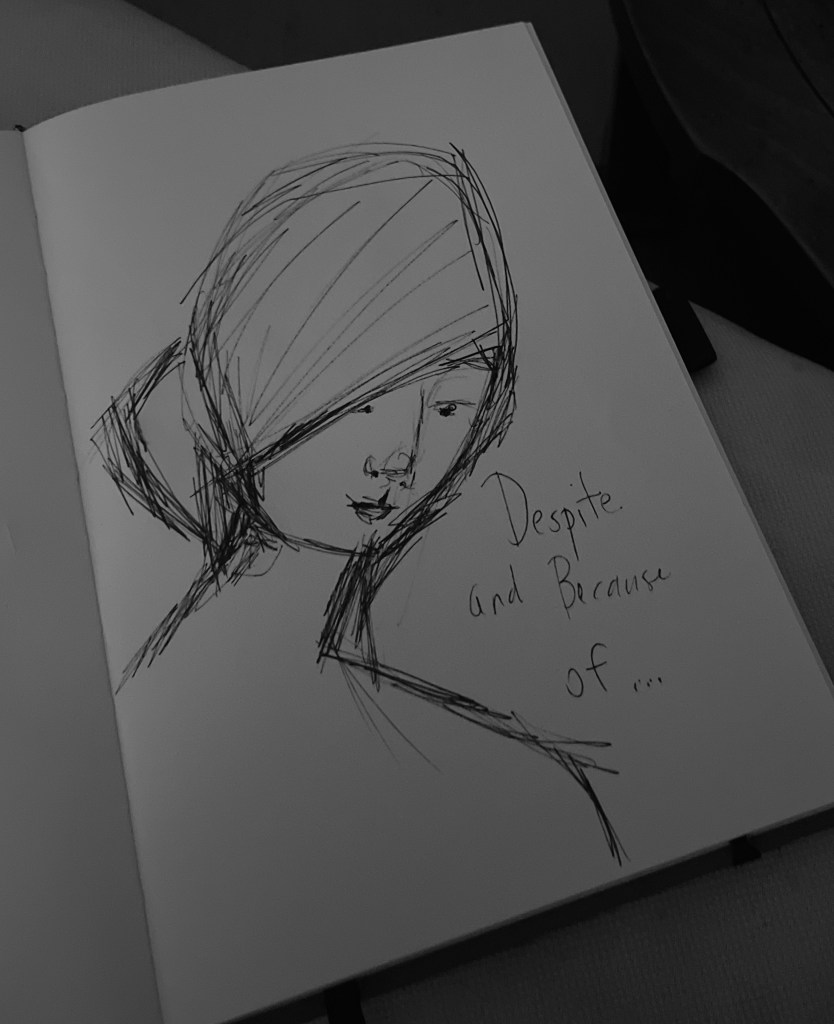
Most of my life I’ve been nurtured by the pencil in hand, a piece of paper, a margin that invites.
Art sustains me.
A wise Dr. and author, Curt Thompson reminds often of attachment that we as children needed to be “seen, safe, soothed and secure” and that need is innate. We will always be in pursuit.
Embraced By Grace
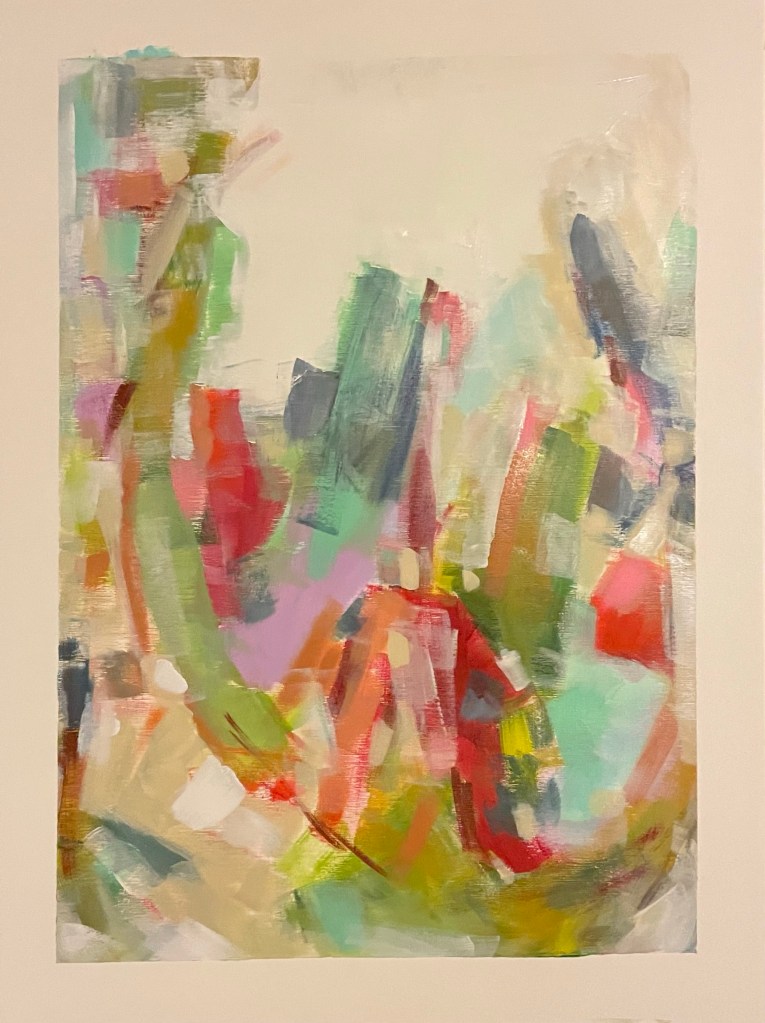
Interestingly, adding color to paper and hinting at an emotion are when I feel these needs are known most and met.
How about you?
Is it art?
Music?
Prayer?
or something else.
I hope you know this “withness with God” often.
You are loved.
Even if the child in you lacked one of the “s”’s.
She’s still there, self-aware, surrendered and seeking solace in the sweet places she’s found herself
At first, it felt brave to find and reread a short story I wrote years ago. I’d written it as a submission to a Southern Writer’s competition. I never heard back. This writing thing is like this art thing, you gotta do it for love.
Now it just feels tender. Plus, I don’t want it to fade away.
Not many of my family members notice my writing and so it’s not brave only tender. Tender, both to think of my grandparents (the inspiration) and even more so to see myself, my journey, my growth, my not quite fully healed yet story in the story of Evelyn.
Here you go.
Remember, I have no formal education as either a writer or artist.
I just love words and color.
Art and Words
Independent Streak Lisa Anne Tindal
If she could make it without a soul knowing, she knew where she would go.
Down Highway 80 through downtown Savannah, through the mossy oak lined streets and over the bridge crossing marshy low tide waters. She would find that old place, the place she felt known. She would take what she needed, chill some water in the Frigidaire and have crackers and peanut butter.
All would be well.
She’d venture down to the lonely October shore and sit on the sand; she would be on the beach. She would wash her feet in the frothy tide coming in. She’d sleep soundly with the breeze, the little clapboard house by the shore, the place she longed for, left her art there, the place where her dreams began.
The place where someone else now lives, strangely she decided they would welcome her in. She would wake with the autumn sunshine and she would go towards the kitchen, avoiding the tiny room, the space where she painted. She ached to be there again. She longed to have her fingertips covered in paint, to forgo the brush, blending colors with her hands. She would consider painting again, maybe later. She might allow herself to be taken away, to be lost in the translation of her concerns to thick layered colors. “Evelyn”, she might pencil in in the corner, always signing just her first name.
Maybe this evening she thought, when the light comes through the sheers just before the day gives way to night. She might settle in then, lose all track of time and angst. Wouldn’t that be something? Everyone would talk! Evelyn has up and left Austin, she always had an independent streak! She smiled, thinking of all the women at the factory, the gossip, what they would say.
Instead, she drove back home, the little white house, tin-roofed and porch screened in. It was Friday, no telling what was waiting there. Her husband, a carpenter, fisherman, a rounder was waiting. About thirty minutes away, longer if she could drive like she wanted, slow and sort of smooth in her baby blue Impala, if she could she just keep right on going she would. She’d like it to take longer before easing up the hill and cruising, her foot off the gas and over the bridge that marked the creek. She flipped on her blinker, she had to get home.
The highway changed to sandy dirt; the first curve was the sharpest as she passed his cousin’s place. She cracked the window and let the other one down all the way, Remer’s wife would be peering through the parlor window, same time every day, making sure she was coming back home. The one perched on the tractor slowing to see her. The baby brother was watching too, knowing his brother was home from wandering now and waiting for his wife to get herself back home. But she smiled to herself in the last seconds of being alone. Creating pretty things, little flowery dresses, gingham checked and ruffled, art, the works of her hands. Only three days into October and she had made production.
Her fingers were bent and achy, their tips flattened smooth. One hundred little Christmas dresses from four different patterns and each of them the same except their velvety hue; cobalt blue, rich red, emerald green or ivory. Some with broad white collars and some with wide sashes for tying bows cinching perfectly around tiny little waists. For ten hours a day and a Saturday, she had been taken away to a place that was hers, a place she could be proud, a place close enough to feeling free.
She turned onto the path that led her back home. He might be sitting out back on the steps or she might hurry in past the sight of his broad back in bib overalls, bent over the old table cleaning his fish. She wouldn’t ask him what he had done today, only go about her business, get herself out of her slacks and cotton blouse and into her housedress and slippers, he’d been waiting for his supper.
She knew his expectations.
She understood her role.
As she headed towards the kitchen she remembered, there was no rice for supper! Oh, Lord have mercy! She had forgotten to cook that morning. Her husband had gone without, no rice for dinner and none waiting for his supper. She turned back towards the hallway and she saw it there, the old rice pot that was always sittin’ on the stove, it had been thrown up against the sitting room wall. Laying there with the sun coming through the picture window, shining like a flash of warning or a lost coin, either way the rice was not ready, supper would not be on time. There was nothing for her to do now.
She would have to be prepared.
Sooner or later he would barrel through the door, overalls half on and half off and the stub of sucked on cigar loping sideways from his lip. She would know right away; she would detect the smell or not of Pabst Blue Ribbon. She could only hope there wasn’t a deeper smell, the thick scent of warm bourbon or the belligerent tone of clear liquid, meaning there might be anger and she was surely too tired to take him on.
Oh, how she wished her girls were there.
But, long gone they were and with husbands of their own, one feisty and determined and the other followed not too far behind. She hoped the other brother who lived beyond the corn field might pass through. They would talk of the weather or the crops or the President, move to comparing their sorry ass women and how their lives should have turned out differently. But it was looking like a lone night, just the two of them and she had no idea when he might decide to come in.
She turned to listen, as still as she could be and decided he must be occupied with cleaning fish or digging bait or maybe brooding in a close to drunken state. She had time maybe, time to get the rice ready, time to pretend she had not forgotten before leaving for work, leaving her husband here. She reached for the Tupperware and opened its lid to scoop out the white grain into the soon to be boiling pot of water.
She startled when the screen door hinge creaked. She stood still to measure the mood of his feet on the porch. She listened as he grew closer, seemed somehow more a spring in his step. She’d grown accustomed to the heaviness of his stride, his feet like cinder blocks, the way they seemed so thick as if he could barely take steps, pushing himself in a despairingly way. Her heart was pounding. She listened. He stepped into the kitchen and ambled towards the sink and there he lingered. She felt his breathing on the back of her neck, she noticed the scent of his labor and decided today, maybe he had been working. She opened her mouth not sure what to say or which way she should begin. Before she could speak, he came even closer and then turned, his hand on her shoulder, the other one circling around her waist. He cradled her for a moment and then turned and walked away, left her standing there. Butterflies rose up in her belly and fluttered at her throat.
She was frozen in front of the stove; the sensation of his touch had overwhelmed her. She looked at the pot waiting for the boiling water and listened as he ran the bathtub water, longer than usual. What in the world, was he not worried anymore about the well running dry? She realized she had more time. She opened the icebox and pulled out a chicken and the beans. If she hurried, the Crisco would be ready about the time the rice simmered down and the leftover lima beans, she would season them with a fresh “strick o’ lean”. She listened as she worked, his odd behavior allowed her more time. She thought of slipping past the tiny bathroom to the bedroom mirror to check her hair and her face, but she decided not to chance it, he would hear her. She never knew really; she was careful not to wake her sleeping giant of a man. Something might set him off and he’d holler loud from the other side of the wall, probably then he’d let her have it, did she just expect him to go hungry again?
Supper was nearly done ‘bout the time the sky changed from blue to dark and thundering grey. The wind was whipping the loose tin on the back shed and pine limbs were threatening to come through the windows, thick and green they pushed against the windows and then moved away just long enough for her to see where the storm was headed, how long it was staying, the hard rain, the threatening thunder the flash of angry lightning. He’d be back in the kitchen any minute and he’d tell her he knew it all day, he knew a cloud was making up, he saw it coming. She waited and then continued. She floured the chicken and dropped it carefully in while the beans were warming and the rice was filling up the pot, the water making it thick and the way he liked it, thick and fluffed, not mushed together. The aroma filled the room, a later than normal supper. She was scrambling to move the cast iron from the heat for the gravy when he came around the corner. He walked towards the table, pulled his chair out and told her, “You ain’t got to make the gravy.”
He surprised her when he said softly, “I was thinkin’ all day, I sure hope we get a good hard rain.” then asked her how her dressmaking went today. She answered that is was good, he nodded and then just looked away. He told her he had gone to town and that he talked with a man about helping a man with some carpentry. Rumor had it that there were new houses coming in just out past the grocery store, that a Yankee from Carolina had bought up all the land and that somebody told them if you need a good carpenter, well, Austin is your man. He told her that he was sure the rich man had been warned, “You just have to catch him sober or not fishin’”. She listened as he continued, remembering her daddy and how she had been warned about his reputation, his family was good people; but the son was rowdy.
He was a charmer she remembered, his swagger swept her away, upturned lip with an “I got you girl, smile”, he reeled her in. They finished their supper and she rose to clean the dishes as he leaned back in his chair
and told her, “You better get on to bed, they’ll be expecting you early again tomorrow.” She paused, “Good night.” she said and then she barely heard him mumble in reply. She did not remind him she would not be working tomorrow.
The storm had passed, and the windows only open a tiny bit, she listened to the birds in an exchange, singing sweetly one to another, the crickets and the frogs down by the pond would soon join in. Tomorrow she decided, she would go to town, it was Saturday, she might see if he wanted to ride along. She drifted off to sleep, slept like a baby. She woke to the sound of coffee percolating and a strange sense of mystery, of newness and of intrigue. Coffee and cream and the corn flakes and evaporated milk were placed on the table. No words were spoken between them, unfamiliar and awkward, this new way of them. Not his way to think of breakfast.
“I think I’m going to town today.” she offered. He grunted. He had grown accustomed to her independence, gave up on changing or caging her in. She did what her preacher man daddy raised her to do, she was dependable and gave in to most everything, knew when to leave him alone, stay out of his way. He let her veer off on occasion, it gave him his space. He didn’t know what she was up to, what was happening between them? He said okay when she out of nowhere asked, “You want to ride to town with me?” then he instantly regretted his answer.
What in the world? That would mean changing his overalls, changing his plans, putting on clean boots, sitting closer to her than he had in years, all enclosed in her car and barely an arm’s length away from her body. He would be the passenger in her beloved Chevrolet. “You ready?’ she asked. He looked out the window and walked away, never gave an answer. She waited. She wondered. She regretted asking.
Then she heard the rusty creak of the old Nova’s door, the pumping of his foot on the gas to give it the boost it required and the beat up old chassis backed up and bolted through the field and down the roads, swerving she knew it, barely keeping it between the ditches.
She sat as morning changed around her. The corn flakes flat in the bowl, the coffee cold and the house was again silent. She thought of her life, how it could have been. She remembered the cousin who left Georgia and moved to California, became a designer, famous in way she supposed. She rose to wipe the counters, poured the coffee out the back door, took the corn flakes down by the edge of the woods, scraped her bowl, left it all there. She promptly returned to the bedroom, made her bed, knelt down and prayed. She rose to gather the white blouse starched and waiting and navy slacks, flat shoes. She found her blue cameo pin. She washed her face, took the bobby pins from her hair, added red lipstick then blotted it to fade to barely there. Dressed and ready, she grabbed her pocketbook and her keys, her little list, her memorandum and she slammed the door behind her. It was only 8:00 in the morning and she knew he would be down by the river; she had the whole day.
Evelyn slid into the seat of her car, glancing down through the field, corn on either side, the road that led to his family. She popped it in reverse and glided back before turning the other way. She had no idea where she was going, she just knew she was going away. She made it to town too early for lunch, barbeque had been the plan for the day. She decided on the café, found a booth and sat to listen, watch, pay attention to others. A pattern of hers it has always been, comparison of her life to most everyone everywhere, she was an observer. The waitress served her coffee, toast and jelly as she lingered. She thought about possibility, about her husband sitting across the table having a pleasant conversation. She remembered the night before, the glimmer of different, a slight change in him, for them. No idea what to do next, she paid her bill and left, walked out into a perfectly cloudless day and then started her car to go on her way.
Windows down and a scarf tied at her neck, she drove towards the beach and then turned back the other way. Unsure whether to be angry at herself for not going or satisfied that she chose the better thing, she remembered her memorandum and made her way to the McConnell’s Five and Dime.
Barely noon, she still had a lot of day. She opened the door, welcomed by sharp clanging bell. “Well, hello Evelyn”, she heard someone say and she turned to see an old classmate; the one who left the country and made her way to the big city. She smiled, dreading the questions of how and what in the world have you been doing. Evelyn anticipated grand stories of her successful husband, her children, her grandchildren, her brick home, a garden amassed with brilliant flowers, a display of pride and better than. Small talk of family and weather led to nosy interrogations she endured. Inquiries of her husband, of her daughters, of their home and whether she had ever decided to pick back up on being an artist.
She answered all of them, made excuses to hurry up her shopping, nice to see you again, say hello to your mama. She watched her walk away, listened as her heels clickety clacked down the aisle and overheard her words to the cashier, condescension over an apparent mistake in her change. Evelyn stood for a moment and then decided on a change. She slowly pushed her buggy down one aisle and then the next, forgot about the Pine Sol and the detergent, continued on her search until she found it, the small section with the thick ivory papers, the colors and the brushes. A box of crayons, she opened them and smiled over all the colors before closing tightly the lid and setting them down in her buggy. A large brush for backgrounds and a small for details, two or three more for blending and then tubes, oh so very many happy tubes of paint! She inventoried her list, best she could remember she had all she would need.
She paid for her items and danced through the exit doors, elated and enthused. She had decided to go another way, decided not to run away.
As fast as she could go, she made her way back home. She mapped out the afternoon, time allotted her for solitude. She thought of what she might do for a bite to eat, enough to get by until supper, she was excited, so very excited. Barely turning to notice the sister-in-law, the cousins, the brother in the field, she pulled in and unloaded quickly, laid her beautiful things out on the porch. She grabbed the peanut butter and the crackers, ice water and a banana. Remembered the rice then and considered not cooking but decided it’ll only take a minute, might as well do thisfor him. It was expected and it required so very little of her, put the water in the pot, the rice does the boiling, cover it with a lid and just leave it there. It will be there for him, whenever and however he comes back in. It was such a little gesture, somehow, she saw it now, as a gift.
All of that accomplished, she found a big old sheet, spread it out on the floor and made a place for her paper. She found an old piece of wood, leaned it up against the screen and with a rusty nail positioned her idea of an easel for her paper canvas. Jar filled with water and brushes soaking, she found an old broken dish and made herself a palette. Vibrant blue was her background and greens, red and purple followed. With no idea of how to begin, what to paint, she simply layered colors.
She stood back and admired the symmetry, the way one color spilled over to another bordered by heavy tint turning to faint shade and shadow. She found the box and crayons and added flowing lines in varying length, swaying-like layers, she decided they reminded her of gowns. So, she quickly added shoulders, gauzy sleeves over arms and shapes of faces titled one way or another. She added ruddy cheeks and pale hollowed ones, made barely noticeable bridges of noses and only just hints of blue, brown or green where the women in flowing gowns eyes would be.
She sighed, an audible “Ah!” escaped from her lips and then she felt it, the smile, the filling up because of it of her cheeks. She gazed at the colors, the freedom of them. Seven women on thick paper with flamboyant and joyous colors, all types of women, all of them with stories. She rested then realized time had escaped her. The dusk of the day was approaching. She gathered her jars and her brushes, stuffed crayons back in the box and careful not to ruin the extras, gingerly picked up her papers, picked up the unpeeled banana and nibbled a stale cracker. She scrubbed the brushes and laid them on a dishcloth to dry, turned on the pilot light and then the burner, the rice, oh, Lord, the rice had to be ready! Hurriedly she finished, put everything away and decided chicken from last night would be enough, would be okay. She walked out onto the back porch to see the coral sun setting and she breathed deeply, sat down in the place where he’d be pulling in and rested her bare feet in the soft cool dirt like sand. Her husband would be home eventually; but she wasn’t worried, not afraid.
She made a choice today when she could have chosen another way. She could have chosen rebellion, a trip to Tybee and come what may. She surely did consider it. She could have chosen pity pouting in the discount aisle and she could have chosen to be a fighter for her freedom. Instead, she chose to gently open her own door. Evelyn was caught daydreaming when she heard the familiar sound of him coming around the corner. She thought to get herself together, to hurry back in, stand waiting in the kitchen in a wifely way. She stayed still, she waited. He pulled into the driveway and turned to look her way, puzzled for sure, he smiled and then he shook his head. He walked over to see her and asked, “How was your day?” Before she could answer he told her he was sorry, that he knew she wanted him to go to town today. She smiled and asked about his day, about where he had been. He answered with a grin, told her he drove towards the river then came back to check the pond dam, decided to see the plot of land where the fancy houses would be and ended up back at his brother’s, just sitting around mostly.
She told him supper was about ready and that she had just wanted some air. She reached for her shoes, brushed the sand from her feet and headed back in. He walked beside her, straight with no sign of stagger and he reached for her hand. She did not know what to make of it, she allowed it, she accepted him then. As they stepped towards the porch, she saw the makeshift easel, she remembered the painting. He opened the door and held it for her, and he turned, and he saw it and said nary a word. Supper was different because he kept on being different and when it was done, he pushed his plate to the table’s center and got up out of his chair. She watched as hestepped towards the porch; listened as he stepped back towards her. Her carried the piece of wood made into an easel and tenderly placed it with its still moist colors on the sill of the window that looked out towards the field. Then he shifted it left a little before saying, “That’s somethin’ else! A real pretty paintin’ Evelyn, why don’t you make another one for here.” She stood up from the table and met him in the middle and she knew in her heart, everything would change from here, her independent streak not broken against her will, but gently set free, blended.
I’m nearing the end of a 300 plus page book, “Jewel”, by Bret Lott. I likely would’ve never heard of it had I not heard him describe his journey to writing in an interview on “The Habit” podcast.
Writers of fiction fascinate me.
I once wrote an essay I thought was a short story. It was short, that’s all. It was a love story inspired by my grandparents’ relationship. I don’t remember the title. I remember describing my grandmother and the angst of she and my grandfather’s marriage.
It was sweet. It was honest.
So, why are books good?
Other than the escape they invite or the lull into sleep, I’m saying books are good for another reason.
Books require commitment, relationship, partnership to travel all the way to a destination.
Books invite rest, suggest we’ve not been completely controlled by our phones.
Books are gifts that beckon.
Settle. Enjoy. Stick with it.
I’m about 50 pages to being finished. I’ve stuck with it, this book about family in the South with some language that’s a bit unsettling.
Characters who are true.
Southern women who are strong, strong-willed and wise, children who are dreamers and men who are mostly seeking to be known.
I love the honesty of Lott’s characters.
Next, I’m reading Ann Patchett’s latest, “Tom Lake” mostly because I’m not sure I’ve read a book that captures sibling relationship in the way Patchett did in “The Dutch House”.
What are you reading?
Not self-help or educational.
Give it a try. It’s a departure worth the discipline.
Now, I’m thinking I’ll find my little “short” story and I just might share it with whoever.
“…Be careful, be quiet, do not fear, and do not let your heart be faint… Isaiah 7:4 ESV
Of all the seasons, Fall feels most like either a resistance to or a gentle walk with open hearts and hands into new.
Fresh wind, fresh chances to let things die (finally) and wait for new after the coming Winter, uncertainty of hard and cold.
Waiting requires hope and hope never disappoints. An open heart, hands opened to let God handle what you’ve been clenching way too long.
The leaves are loosened from the trees, their dance is light and free, letting go with glee. There’s a metaphor here, a message for me maybe you, indeed.
Open hands, open heart, thriving souls.
I plant tiny and tender violas, the most fragile of petals and yet they survive the change, the wind, the cooler and brittle air.
Precious flowers, every year planted to sort of honor my grandmother and to tangibly decide to believe,
Hope won’t put me to shame.
Hope never disappoints.
Hope is soft, a demeanor of belief, whereas as dread, fear, speculation or defeat offer nothing at all,
only take and tie up our precious souls, leave us to decide we’re worthless, discarded, without hope.
Choose to hope.
“Surely there is a future, and your hope will not be cut off.” Proverbs 23:18 ESV
“Why do you use/love weird words?” one or both of my children.
In some form or fashion, the question often came. And I’d say what was true.
“I love words. If we’ve got ‘em we need to use them.”
I have an old dictionary, 1962 Webster’s. The pages are the color of clay and smelly.
But, I love words. I just do. God woke me with the question again of why I have a pattern of making myself small, why small feels safe. A word came, do I try to “diminish” my worth? Alone and small feels safe. And yet, I am certain there’s only a tiny bit I know of all who might be influenced by my story, by my creative expression.
There’s safety in being diminished. I looked the word up in the old dictionary and it’s just what I thought, “to make less, weaken, impair”.
God led me to Exodus. The people were discontent with the bountiful provision. Most translations say they were “grumbling” and yet, the more appropriate and earlier translated word was “murmuring”.
Dancing Leaves, one of 3
Again, I go to Webster. To murmur is to “utter complaints in a low doleful sound”. And “doleful” is a sound that someone makes when they are sorrowful or in dismay.
The whole congregation of Israel was “grumbling”. In the ESV version, the word is used eight times in Chapter 16.
I’m the KJV, the word is “murmurings”.
“I have heard the murmurings of the children of Israel: speak unto them, saying, At even ye shall eat flesh, and in the morning ye shall be filled with bread; and ye shall know that I am the LORD your God.” Exodus 16:12 KJV
Yesterday, I saw faces of grocery store shoppers. I saw a dullness, an apathy, a less than attentive glance to those around them. I saw “doleful” expressions.
Why does one word matter? Murmuring comes from dismay. Grumbling is well just more of a selfish grouchiness.
It matters because of the invitation to know that God sees you, hears your quiet complaint. God is provision. Your woeful or questioning wilderness is being noticed.
And just as the Lord told the Israelites even in their hopeless state…I cared for you. He is caring for me.
For you.
For the generations that are here and to come because of you.
“And Moses said, This is the thing which the LORD commandeth, Fill an omer of it to be kept for your generations; that they may see the bread wherewith I have fed you in the wilderness, when I brought you forth from the land of Egypt.” Exodus 16:32 KJV
With a tiny bit of trepidation and the need to refresh my memory, I’ve just searched to find a short devotion I submitted for publication that was rejected.
I often am met with puzzled expressions or worse, a squinty eyed and wrinkled forehead over the things I say, the things I think.
I responded to a poll by an author who is studying brain science, how the science of the brain is effected by relational trauma.
I typed…
“I’d love to know if memories of trauma can ever completely go away?”
Once, in a conversation with a clinician friend who is an expert in all things amygdala related, I proposed
One day, what if one day, scientists discover how to surgically remove traumatic memories from the brain?
My friend looked at me, knowing I was serious and it seemed, she was deeply moved by such an imaginative hope.
I realize I’m sometimes too much for some people.
I reread my submitted devotion, maybe too heavy or even “far fetched” over the possibility that Jesus might have a mind like mine. Or maybe, the tone was wrong, less than perfect grammar or perhaps, it was not a fit for a book of 40 days to a stronger, more courageous mind I suppose.
Rejection doesn’t bother me as much as before. I love writing. I’m owning my voice, honesty and all.
So here’s what I wrote:
A Mind Like Mine, Is it Possible?
Lisa Anne Tindal
Key Verse: “For who has understood the mind of the Lord so as to instruct him?” ‘ But we have the mind of Christ.” I Corinthians 2:16 ESV
Countless days I have felt the unwelcome weight on my chest, the creeping up of vice-like unrest brought on by my thoughts.The recurring nuisance of anxiety for no reason that feels like entrapment.
I pause and question the cause. I say private prayers, take long walks and do something creative with my hands. I clean. I rearrange shelves or entire rooms. I do some stretches. I put my legs against the wall and my hands on my chest.
I remind myself of the most important, although not instantaneous response.
I remind myself that my loving Father would never desire or cause me to feel this way. I recall the promise in II Timothy, written by Paul, a prisoner awaiting execution. I say to myself, “This feeling is not from God.”.
“…for God gave us not a spirit of fear but of power and love and self-control.” II Timothy 1:7 ESV
I also remind myself of Paul’s words that assert we are able to understand our Father God because we have the mind of Christ. Our minds are changed, comforted, informed by the Holy Spirit in us when we accept Jesus as our Savior.
“For who has understood the mind of the Lord so as to instruct him?” ‘ But we have the mind of Christ.” I Corinthians 2:16 ESV
The thought of having the mind of Christ captivates me and stirs curiosity over the characteristics that would define such a mind.
So, I created a poll on Instagram, added a little note saying “doin’ some research”. I asked my followers to give me a word to describe the mind of Jesus. There was nary an answer, lots of hearts and likes, but no participation in the poll.
Could it be the question was beyond actually believing that our minds could be “Jesus-like”?
Just last week, questions over a decision prompted questions of God.
“Why the resistance to your call on my life?”
“Have I ever felt that I knew your will without question, or have I spent my whole life making iffy choices that you’ve redeemed?”
“What is your will for me God?” I opened my Bible to search for a verse in Micah. Instead, my eyes met a sketch I’d created on the pages of Joshua.
A woman with a posture of listening and my handwriting reminding, “Incline your heart to the Lord.” ( Joshua 24:23 ESV) and boldly circled verses with the words,sincerity, faithfulness.
Sincerity and faithfulness,
I would insert in the IG poll because I have known my Savior to be sincere in His faithfulness to me.
I wonder how my fear, anxiety and resistance might fade if I dared to believe that because I have the mind of Christ, with humble grace I could say in time, “His mind is like mine.”
What a beautiful thought worth embracing.
I can be sincere, and I can choose faithfulness. My mind can be without torment.
My mind can be changed by my heart’s position. My mind can be gently faithful and with sincerity, become more content, less shaken.
Confidently, “more me”.
A Prayer:
Lord, you understand our minds unrelentingly. You lead us to be questioners in your Will. You answer. You calm. You strengthen our minds. You help us see ourselves from your perspective. You help our minds to connect with our hearts and to be still, to know what is good, acceptable and perfect according to you.Incline us to your heart, Lord. We will trust that our minds will follow.
I’m not sure I’m a devotion writer. I’m not sure about writing at all. I’m only sure that as I write, as I grow.
I’m less bothered by this “enigmatic” mind of mine.
Continue and believe.
With sincerity and faithfulness, you are deeply loved.
I wonder if it’s a common feeling, the juxtaposition of two pursuits when you become a certain age…
A collector and cherisher of “small things” or an avid “go-after-er” of “limitless”, of all the longings of your heart you’d thought might not be for you, possibilities.
Maybe it’s both in a gentle and knowing of yourself as your Maker made you.
I bought myself two gifts yesterday on my 63rd birthday, a pear shaped candle and a bangle the rich color of jade, the same shade in the “Restoration” collection now available.
There was nothing I needed, I said with ease.
I just wanted those two things.
I came home to birthday cards and there were flower deliveries on the porch that were surprises and only found because my daughter asked “Is there something for you on the porch?”
And there sat two of the most boldly happy arrangements you can imagine, the colors complements of each other.
My son, my daughter ordered flowers, neither knowing the other hoped to brighten my day, yellow roses, lilies and sunflowers.
Patient, on my porch while I piddled around my solitary home, added touches to a canvas I’ll soon take away because they’re too contrived, too hard, not gentle; curled up with an actual book under my quilt and then moved with small and slow steps for the arrival of my daughter and her family.
For birthday swimming.
Dinner and cheesecake with cherries on top.
Later, I sat and lit the candle, knowing it wouldn’t be the same, the waxy drips changing the shape no longer to pear but possibly just a blob.
No telling.
My sister called, the last of my siblings to wish me a Happy Day and we talked past my husband going to bed.
About life, about children, about books, about hope.
About knowing we can never know how our lives or the lives of our children will unfold.
But we can know that to teach them not to expect to always know, only to confidently and gently continue on.
And we can live from that knowing for ourselves and we can carry on, enlightened by life in all the ways hard and soft.
So that we can be our truest selves…mamas, sisters, wives, friends, grandmothers, aunts and whatever our hope without limits leaves on our doorsteps.
We can be where we are because of all we’ve come from and all we now know.
We can love small things and we can believe in the limitless beauty of brave pursuits too.
I saw the man again on Monday but, yesterday I wasn’t paying attention. I neglected to glance over to find the front yard of the trailer hidden in a shady hollow place.
Overgrown it was the day I saw the pair standing so far apart they would need to raise their voices.
The grass was high like wheat and a man with a flock of blonde hair all crazy stood with his hands crossed and a positioning of his torso saying “I ain’t staying much longer.”
Facing him was another man, his head tilted to one side in a way that said sincerity.
I wondered about the relationship.
Father, step-father, mama’s friend, uncle or older brother.
I wondered who had caused the crack in relationship and who was resisting more the reconciliation of it.
I also wonder why I wonder. Why I see humans in conditions that are fragile and why God made me to want those conditions to be better.
I know God made me this way and somehow I know the intervening is not for me to accomplish, only God.
So, I pray for strangers. I just do.
And I think about them. I still pause to consider.
“What’s their story?”
I woke with thoughts about love this morning, about the importance of “for my part” demonstrating love.
Love that doesn’t put us in danger of emotional harm is just a positioning of our hearts and mind, we can stay safe in showing love when it’s hard by just deciding we want restoration for someone, we want them to know they are loved by their Creator and if they’ll allow it, by others too.
“Relationship, especially family, requires a commitment to relationship despite differences, dysfunction, and most importantly delays in the other person longing in the same way for relationship.”
I laid still in the place of very good and needed rest and questioned why these words came.
I figured it must be that I’m still curious about the family in the overgrown yard.
I saw the older man a second time. Tall and skinny, a bearded man with baggy britches and an oddly colored pipe dangling from his mouth.
He was swaying in a rhythm with a weed eater as he cleared and cleaned the high grass and weeds.
He was making the situation better.
There was contentment in his movements.
Maybe in the knowledge that he tried and is trying. So, I’ll drive past the place of these two people again next week and I’ll believe the best is being done to restore what’s been neglected or wronged.
And I’ll believe more strongly in the truth of love being demonstrated in small ways to invite change (even if we don’t get to see it).
Because, it’s not about us anyway, it’s about the one who’s messed up and in need of love believing it may be possible…
Restoration.
“God is a restorative God. He is restoring all losses.” John Eldredge, author of “Get Your Life Back”
Continue and believe.
“Above all, keep loving one another earnestly, since love covers a multitude of sins.” 1 Peter 4:8 ESV
I discovered yesterday that 2023 marks a “Jubilee” year for me as I approach my birthday. It’s surprisingly tender, this discovery…almost too difficult to put into words. Maybe I will, maybe I’ll just rest in the discovery of a year symbolic of release and restoration.
we run away from our discomfort... but it doesn't leave us. to heal we need to turn around and face it, experience it and once we truly do we are out of it. We heal and we grow.
2 Timothy 1:7-8 For the Spirit God gave us does not make us timid, but gives us power, love and self-discipline. This blog is about my Christian walk. Join me for the adventure.








 Lisa Anne Tindal